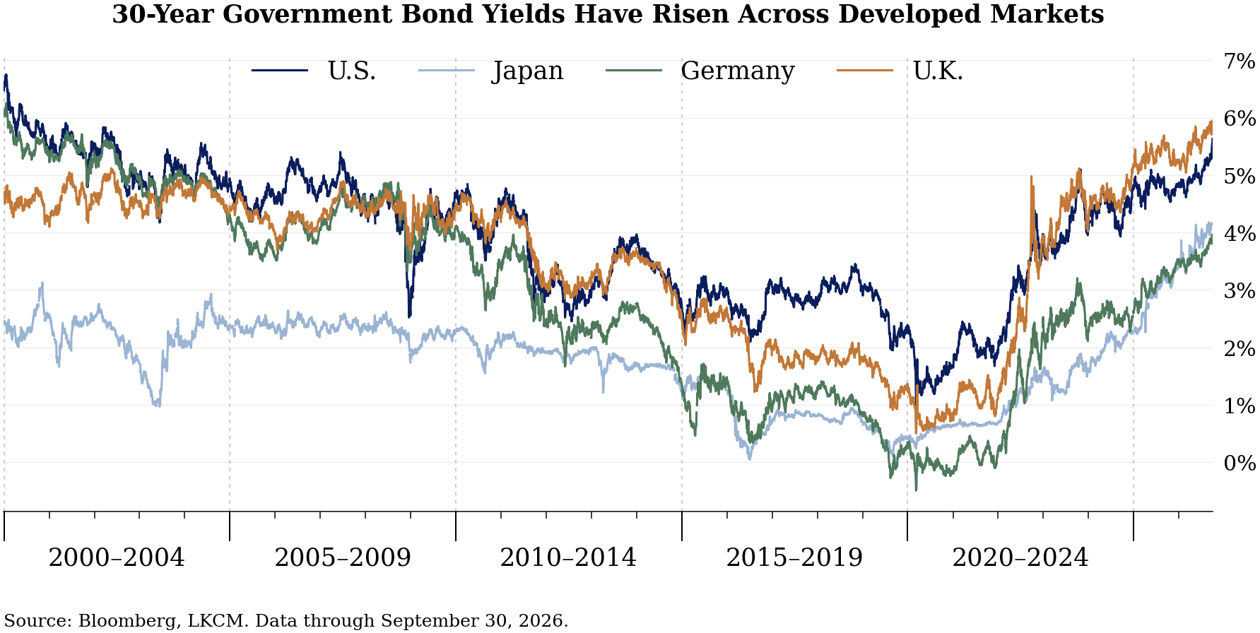
Capital has rarely been in greater demand, and its cost is rising accordingly. The year began with investors expecting two Federal Reserve interest rate cuts; by the end of the third quarter, the central bank had raised rates and signaled another increase before year-end. Meanwhile, long-term sovereign bond yields have risen across developed markets. The federal government continues to run unusually large budget deficits despite a strong economy. At the same time, the AI infrastructure buildout requires enormous private investment in data centers, semiconductors, power generation, and related equipment. Government borrowing and private investment are competing for the same pool of savings, adding upward pressure on the cost of capital.
For investors, both the level of interest rates and the pace at which they rise matter. Current bond yields are not necessarily inconsistent with strong economic growth, but a rapid rise in the cost of capital can be more disruptive. Companies that must refinance debt face sharply higher interest expense as existing obligations mature, while businesses that rely on variable-rate financing feel the effect immediately. Smaller companies can be particularly exposed because they generally have fewer financing alternatives and rely more heavily on variable-rate debt.
Why rates are rising matters as much as how far they rise. Strong economic growth and high expected returns on private investment can increase demand for capital and may raise the economy’s neutral interest rate. Rising yields are more concerning when they reflect persistent deficits, higher inflation expectations, or growing concern about government financing requirements. We believe economic strength and unusually strong private demand for capital explain an important part of the recent increase, although fiscal pressures may also be a contributing factor. Higher rates do not necessarily portend weaker growth or lower equity prices. Strong earnings can offset some of the pressure higher discount rates place on valuations, but a higher cost of capital raises the required return for every investment.
ECONOMY
One of the year’s most important developments has been the rise in long-term government bond yields across developed markets. Much of the U.S. increase has come from higher inflation-adjusted, or “real” yields, rather than higher measured inflation expectations. One explanation is that the economy’s neutral interest rate may have moved higher. The neutral rate is the real interest rate that balances the demand for capital with the supply of savings while keeping the economy near full employment and inflation stable. Strong economic growth and an unusually large private-sector investment cycle are increasing demand for capital and may be pushing that equilibrium rate higher.
The buildout of AI infrastructure is contributing to strong economic growth. AI-related investment now accounts for roughly 40% of four-quarter real gross domestic product (GDP) growth, and the economy would have been considerably softer without it. Yet despite AI’s growing contribution, overall economic growth has not accelerated materially. One explanation is that the economy has been operating near full employment, leaving limited capacity to accommodate such a large investment cycle without diverting resources from other uses. As AI investment has risen as a share of nonfarm business GDP, non-AI investment has declined by nearly the same amount, suggesting that the AI buildout may be crowding out other investment rather than simply adding to economic growth.
The growing demand for capital is already visible in corporate debt markets. Investment-grade corporate debt issuance has risen 26% this year, led by technology companies. Debt issued by large technology companies to finance AI-related capital spending is expected to equal roughly 70% of the U.S. budget deficit this year. Nine of the ten largest debt offerings this year have come from technology companies.
Federal debt surpassed $40 trillion in August, as the U.S. continues to run exceptionally large budget deficits despite strong economic growth. The deficit totaled $1.8 trillion during the first ten months of fiscal 2026 and approximately $2 trillion over the preceding twelve months. Private investment and government borrowing are therefore making unusually large demands on the same pool of savings. The issue is not whether the Treasury can find buyers for its debt, but the return those buyers may require as these demands compete for capital.
While much of the recent increase in long-term yields appears to reflect higher real rates rather than rising inflation expectations, the near-term inflation outlook became more complicated in the third quarter. Much of this recent pressure has come from supply-side shocks rather than stronger consumer demand. Tariffs have increased the cost of imported goods, AI investment has intensified competition for scarce resources, and disruptions in energy markets have raised transportation and production costs. AI creates a different tension. Its potential to improve productivity and profitability is driving large-scale investment, but many of the resources required to support that investment are already scarce. Labor-saving technology becomes more valuable when labor is expensive, yet building the infrastructure to support it requires enormous amounts of power, equipment, materials, skilled labor, and capital. Over time, AI could allow businesses to produce more with fewer inputs and reduce inflationary pressure. In the near term, however, this historic investment cycle is inflationary.
Crude oil prices have retraced from recent highs, but tight refining capacity and low product inventories have kept diesel and other refined products elevated. Distillate inventories recently fell to approximately 102 million barrels, their lowest month-end level since 2005, while diesel prices were 77% higher than a year earlier. Diesel is critical input in the production and delivery of physical goods, affecting freight, agriculture, construction, and manufacturing. Falling crude prices therefore may not provide the near-term inflation relief they normally would.
Against this backdrop, the Federal Reserve has begun to raise the cost of capital at the short end of the yield curve. The reversal in expectations during 2026 has been striking. The year began with investors anticipating two rate cuts. By September, the central bank had instead raised rates by 0.25% and indicated another hike was likely before year-end.
Higher real rates ultimately contain their own corrective mechanism. As financing costs rise, some corporate investments no longer clear the required return threshold, mortgage demand declines, and higher returns encourage more saving. That mechanism may operate more slowly in the current cycle. Extraordinarily profitable, cash-rich technology companies are undertaking a large portion of the incremental investment. Expected strategic returns and perceived competitive necessity drive much of their AI capital investment, limiting the impact of the marginal cost of borrowing. A 0.25% or 0.50% rate increase is unlikely to cause Microsoft, Alphabet, Meta Platforms, or Amazon to cancel a data center they believe is strategically necessary.
This creates an unusual challenge for monetary policy, as the companies generating much of the incremental demand for capital may be among the least sensitive to interest rates. At the same time, the burden of tightening falls disproportionately on households, housing, small companies, and leveraged borrowers. The Federal Reserve could therefore restrain the broader economy before materially slowing the investment cycle driving much of the demand for capital.
MARKETS
The level and pace of interest rates matter for individual companies, but higher rates are not necessarily an impediment to positive equity returns when they reflect stronger economic growth. History bears this out. Across seven Federal Reserve hiking cycles since 1980, the Standard & Poor’s 500 Index produced positive returns over every full tightening cycle, ranging from 4% to 28%. Although stocks have tended to pause after the initial rate hike, the market eventually peaked six months to nearly three years after tightening began. The path was not always smooth, but when the Federal Reserve raises rates in response to strong demand, earnings growth can offset some of the pressure higher rates place on valuation multiples. This year is proving to be a good example of that dynamic.
The durability of those earnings will depend in part on how the economy absorbs the AI investment cycle. Several paths are possible. AI investment could disappoint if the productivity gains ultimately prove insufficient to justify the capital committed. Strong productivity could instead persist while capacity constraints make further investment increasingly expensive. Wage growth could outpace productivity if demand exceeds the economy’s productive capacity, putting renewed pressure on margins and inflation. Finally, central banks could raise rates far enough to weaken investment and broader demand before new capacity has time to come online. Each poses a risk to returns on today’s AI investment.
This year’s equity gains have been driven by earnings growth rather than multiple expansion. The Standard & Poor’s 500 Index has risen even as its price-to-earnings multiple has declined from 22X at the beginning of the year to 19X today.
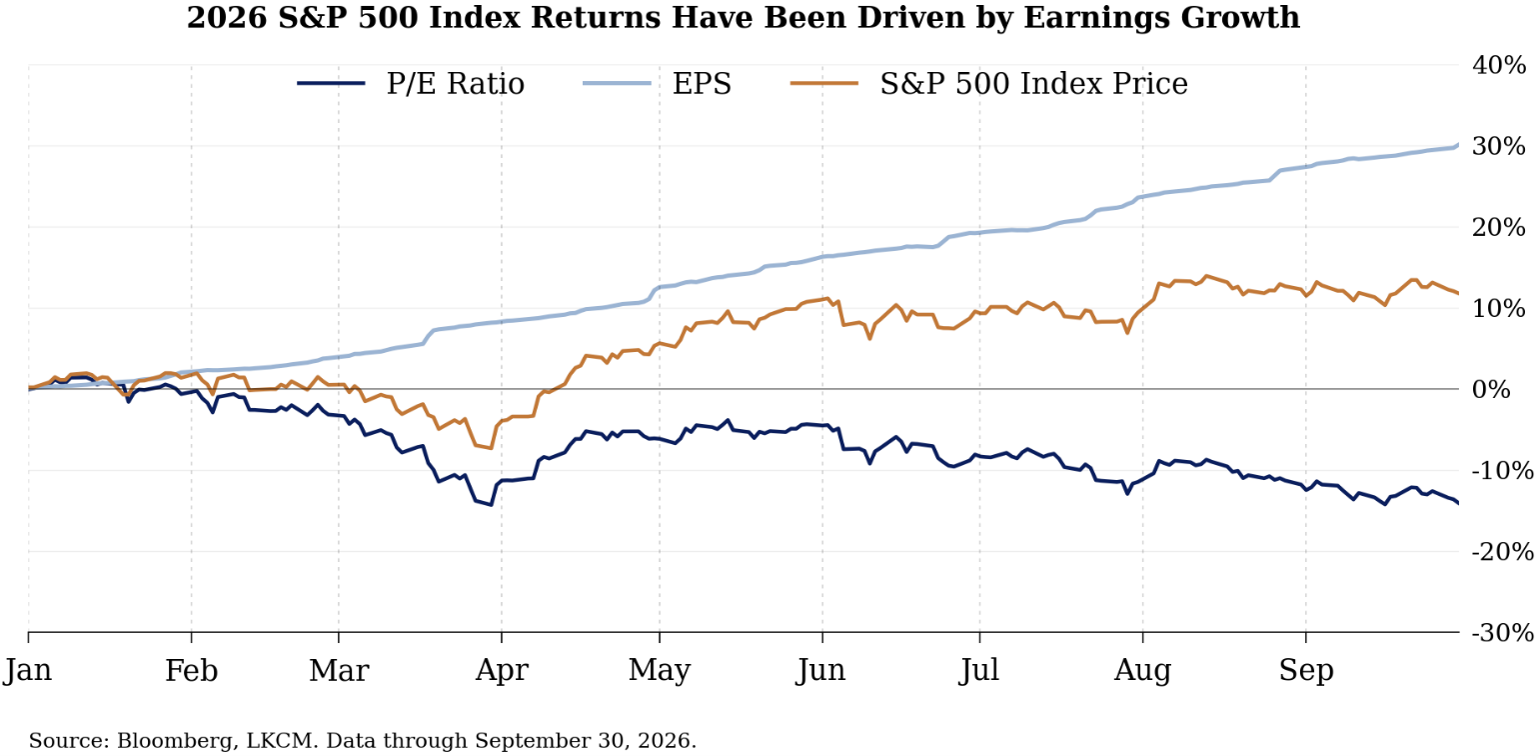
The market multiple has moved closely with the inverse of 10-Year Treasury yields, with multiples declining as yields have risen. Higher Treasury yields compete with equities for investor attention while simultaneously raising the discount rate applied to future corporate earnings. Stocks have become cheaper in absolute terms but are not more attractive relative to interest rates. A reversal in rising yields, likely triggered by a decisive move lower in oil prices, would make us more bullish on equity valuations.
Households continue to spend, credit remains readily available, and businesses are investing in technology and physical capacity. Together, these activities reinforce one another and have translated into strong revenue growth and expanding margins. Second quarter earnings increased 29% from a year earlier, the second consecutive quarter of growth above 20%, while revenues rose more than 13%, the fastest pace since 2022. That earnings growth pace is unusual outside a post-recession recovery.
Strong index-level earnings and returns have masked unusually narrow market participation. The ten largest companies now account for approximately 40% of the Standard & Poor’s 500 Index, giving their performance an outsized influence on the index. At the end of the quarter, only 21.3% of index companies were in an uptrend, with their stock prices trading above their 50-day moving averages. That is the lowest figure for a period when the index was within 2% of an all-time high since the data series began in 1990. Market concentration is also evident in earnings, with Nvidia and Micron alone accounting for roughly a third of expected 2026 index earnings growth and the ten largest contributors accounting for 65%.
Participation had been broadening as recently as July, when easing inflation and catch-up earnings among smaller and non-technology companies lifted the equal-weighted index ahead of its cap-weighted counterpart. That reversed sharply in September as oil prices surged and the Federal Reserve resumed hiking. The equal-weighted index fell nearly 5% for the month while the cap-weighted index was roughly flat. The reversal leaves market returns more dependent than usual on a relatively small number of companies continuing to deliver.
The race to build AI infrastructure remains in full force, but technological success does not guarantee attractive returns on invested capital. Traditional network effects do not apply in the same way. Each user interacts with the model rather than with other users. If a better model emerges, customers can switch relatively easily, which can limit pricing power. AI also has meaningful variable costs because greater usage requires additional computing resources, unlike traditional software, where the cost of serving an additional customer can be negligible.
The location of that computing could also change. Computing was once expected to remain concentrated in large mainframes before migrating to personal computers and eventually handheld devices. AI could follow a similar path as increasingly capable models run locally on computers, phones, vehicles, and other devices rather than relying on centralized data centers. AI could therefore become pervasive without requiring as much centralized infrastructure as today’s investment plans anticipate. The question is not whether AI will become an important technology, but whether the revenues and cash flows generated by today’s infrastructure investments will justify the capital being committed.
CONCLUSION
For investors, the reason interest rates are rising matters as much as how far they rise. Higher yields driven by resilient economic growth and strong private demand for capital can coexist with healthy corporate earnings, if long-term inflation expectations remain contained. By contrast, higher yields driven by rising inflation expectations, fiscal concerns, or a loss of central bank credibility would present a more difficult environment for equities and bonds.
The impact of a higher cost of capital will be uneven. Companies with strong balance sheets, durable earnings, and substantial free cash flow are better able to absorb higher financing costs. As capital becomes more expensive, borrower quality, returns on incremental investment, and the price investors pay for those returns become increasingly important. Capital remains readily available, but it is no longer inexpensive.
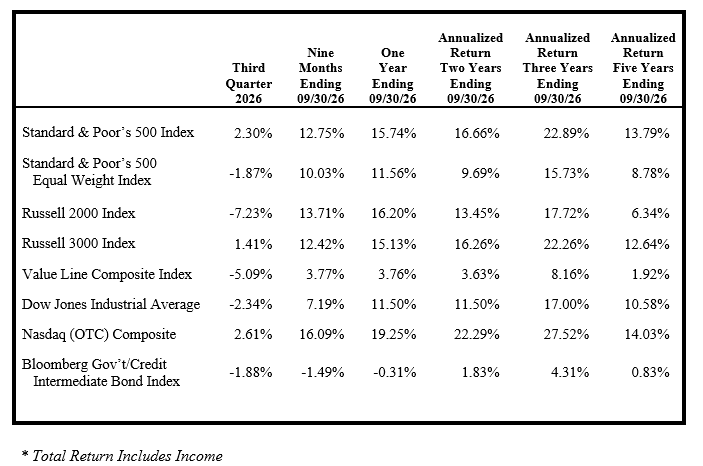
FINANCIAL MARKET TOTAL RETURN*
Michael C. Yeager, CFA
October 3, 2026
IMPORTANT INFORMATION
The commentary set forth herein represents the views of Luther King Capital Management and its investment professionals at the time indicated and is subject to change without notice. The commentary set forth herein was prepared by Luther King Capital Management based upon information that it believes to be reliable. Luther King Capital Management expressly disclaims any responsibility to update the commentary set forth herein for any events occurring after the date indicated herein or otherwise.
The commentary and other information set forth herein do not constitute an offer to sell, a solicitation to buy, or a recommendation for any security, nor do they constitute investment advice or an offer to provide investment advisory or other services by Luther King Capital Management. The commentary and other information contained herein shall not be construed as financial or investment advice on any matter set forth herein, and Luther King Capital Management expressly disclaims all liability in respect of any actions taken based on the commentary and information set forth herein.